

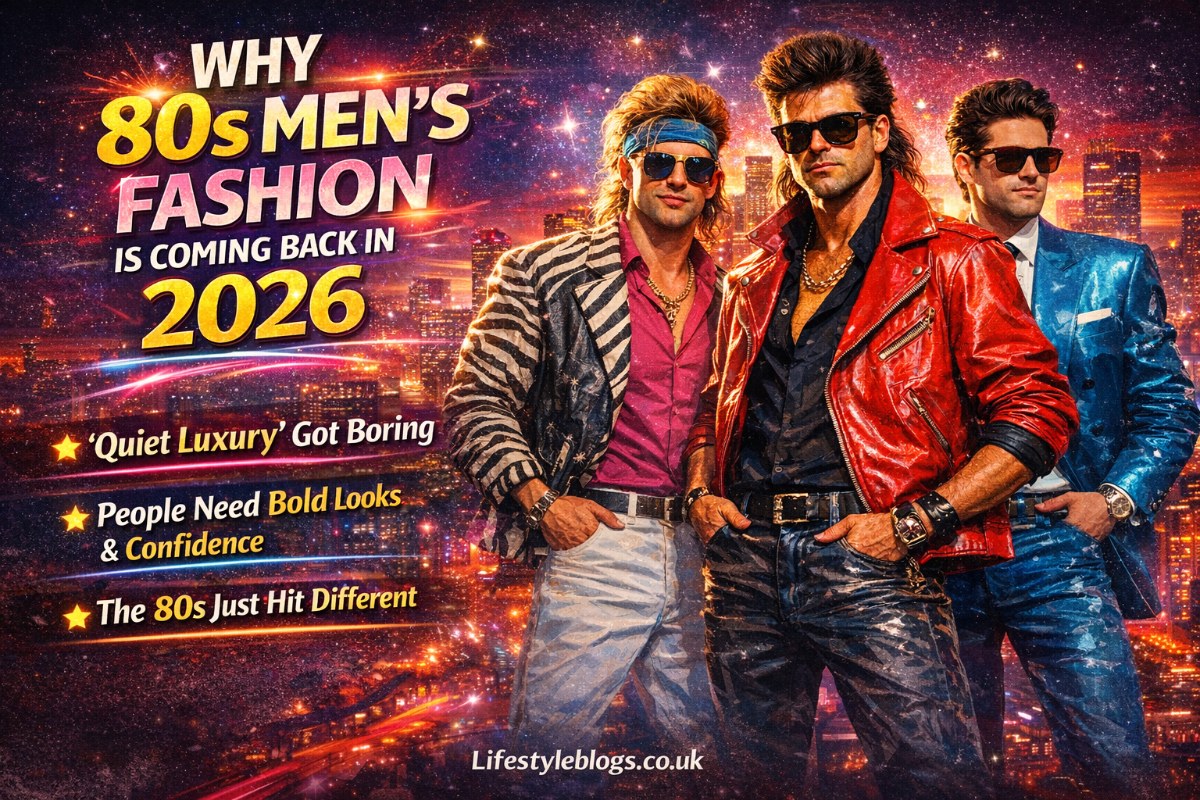
Quick Answer: 80s men’s fashion is coming back in 2026 because quiet luxury lost its meaning, Gen Z is hungry for bold aesthetics, and SS26 runways from Versace, Dior, Celine, and Saint Laurent all confirmed the shift simultaneously. WGSN and Pinterest data back it up — this isn’t a vibe, it’s a measurable trend driven by the 20–30 year fashion cycle hitting its natural reset point.
If someone told you two years ago that acid wash denim and gold hardware were about to take over menswear, you’d have laughed them out of the room. And fair enough — it would’ve sounded insane.
But here we are. Dior brought back the denim miniskirt. Versace showed up with teal and magenta color-blocked jackets. Celine put high-waisted jeans front and center with chunky belts that mean business. This isn’t one designer having a retro moment — this is a full-on shift happening across the board, and it’s been building for a while.
So what’s actually driving it? Because it’s not just nostalgia.
People got bored of looking invisible
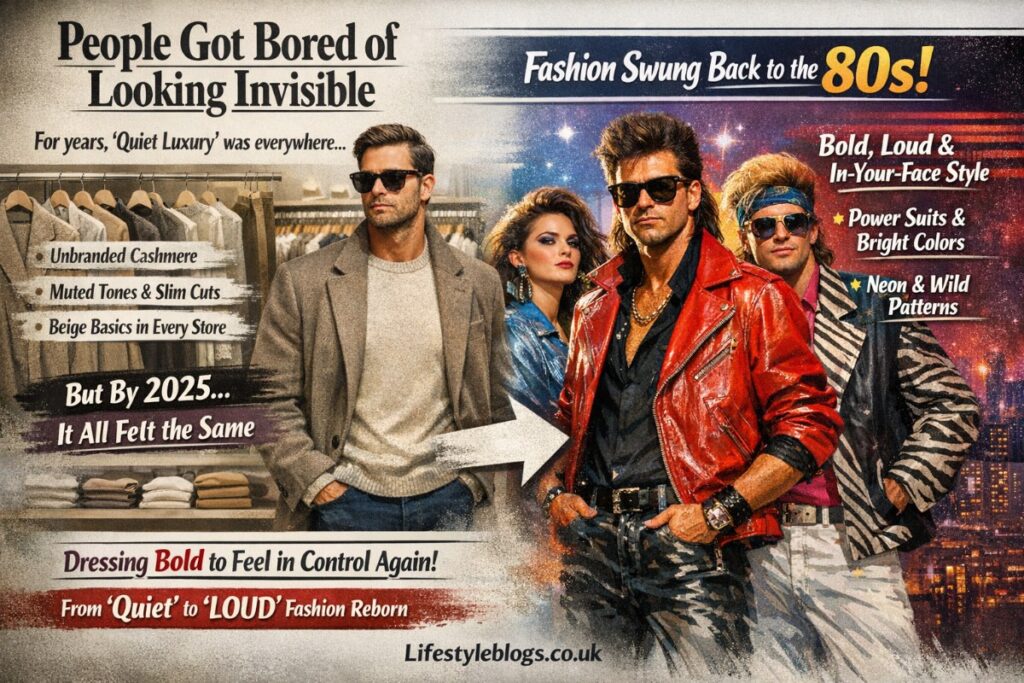
For about four or five years, the coolest thing a man could do was look like he wasn’t trying. Quiet luxury ruled everything — unbranded cashmere, muted tones, slim cuts, the whole “I’m rich but I don’t need to show it” energy.
And look, it worked. For a while.
The problem is that by 2025, every high street store had a quiet luxury section. Zara, H&M, ASOS — all of them were selling the same beige basics. When the aesthetic that’s supposed to signal taste becomes the most generic option on the rack, it stops meaning anything.
That’s exactly when fashion swings back hard in the opposite direction. And the opposite of invisible is the 1980s — a decade built on opulence dressing, visual boldness, and the idea that your clothes should say something before you even open your mouth. The Y2K aesthetic had its moment too, but it was always more about irony and nostalgia than genuine confidence. The 80s revival feels different — it’s not ironic at all. It’s sincere.
WGSN’s Lisa White — she’s their director of strategic forecasting, someone whose job is literally to predict where fashion is going before it gets there — put it this way: consumers are looking for “powerful tools for emotional release” through what they wear. People are stressed, things feel uncertain, and dressing boldly is one of the few ways to feel like you’re in control of something.
The 80s were born out of the same energy — Thatcher, Reagan, economic anxiety — and the fashion from that era reflected exactly that desire to project confidence loudly.
The numbers back this up — it’s not just vibes
This isn’t just fashion writers talking to each other. The actual consumer data tells the same story.
Pinterest Predicts — their annual forecast built on billions of real searches — flagged sculpted shoulders, chunky belts, baggy suits, gold cuffs, and colorful jackets as rising searches heading into 2026. These aren’t people browsing for inspiration. These are people actively looking to buy.
Depop saw a 50%+ spike in searches for 80s vintage men’s pieces in 2025. That’s a massive jump on a resale platform where search volume directly translates to purchase intent.
On TikTok, hashtags around 80s mens fashion and acid wash denim have been clocking tens of millions of views — and unlike Pinterest browsing, TikTok engagement converts fast. When a look goes viral there, it sells out within days.
And WGSN’s Lorna Hall — their fashion content director — specifically called out gold as “ascending as opulence emerges out of the growing influence of 80s status dressing.” When WGSN says something is coming, brands adjust their production. Fabric mills shift their output. Buyers change their purchasing plans. It’s not trend commentary — it’s the infrastructure of the fashion industry moving.
The timing makes perfect sense if you know how fashion cycles work
There’s a well-documented pattern in fashion — roughly every 20 to 30 years, a decade gets its moment back. McKinsey’s fashion research has written about this cycle consistently. The logic is straightforward: the generation that grew up in a particular era eventually reaches positions of real creative and cultural influence, and they start pulling from what they actually remember rather than what they’ve researched.
The designers running major houses in 2026 grew up in the 80s. Dario Vitale at Versace, the creative teams at Saint Laurent, Valentino, Celine — these people aren’t referencing the 80s the way you’d reference a history book. They’re pulling from memory. That makes the work feel more genuine, more specific, and less like costume.
On the consumer side, Gen Z never lived through the 80s. So acid wash denim and gold hardware don’t carry any of the baggage that people who actually wore them in 1987 might feel. For younger buyers, it’s fresh. It doesn’t feel like their parents’ wardrobe — it feels like something genuinely new.
What the SS26 runways actually showed?
This is where it stops being theory and becomes evidence you can point to.
Versace SS26 under Dario Vitale came out with color-blocked denim in a full Miami Beach palette — teal, purple, magenta, vibrant blue. High-waisted silhouettes, clamdigger pants, denim vests. The collection got picked up by Harry Styles, Julia Roberts, and Robyn almost immediately, which means it moved from runway to real-world visibility faster than most.
Dior brought back the denim miniskirt — a piece that was central to Calvin Klein Jeans’ 80s identity. Celine showed high-waisted mom jeans with balloon and carrot-leg trousers — that exaggerated tapered silhouette that defined 80s denim at its most distinctive. The carrot-leg specifically is one of the clearest signals of the denim revival happening right now — it’s an inherently 80s cut that slim-fit culture completely erased for 15 years.
Marni pushed the tapered, exaggerated silhouette even further. Saint Laurent built its entire SS26 energy around bold shoulders and generous 80s volumes — shirts with jutting shoulders from extra-long removable stays, billowing over tapered trousers with paper-bag waists. These are exaggerated silhouettes in the truest sense — proportions deliberately pushed beyond what feels “normal” because that’s exactly what the 80s did.
Valentino leaned into structured shoulders, sheer fabrics, and sequins for its SS26 Fireflies collection — maximalism through texture and shine. Zimmermann showed denim flares and bell-bottoms paired with a puffy-sleeved jacket — indigo flares done properly, the kind that remind you why this silhouette was so powerful the first time around. And Isabel Marant brought leather jackets with an 80s edge for Resort 2026 — voluminous, laser-cut, and deliberately referencing the decade’s attitude toward outerwear.
Amy Leverton, founder of Denim Dudes and one of the most consistently accurate denim analysts in the industry, confirmed the high-waisted 80s silhouette is returning after seeing it on Celine and Dior runways specifically. Her take: “crease-front details and softened acid finishes — optional but advised.” That softened acid finish detail is important — this isn’t the aggressive bleaching of 1987. It’s a refined, modern take on acid finish denim that carries the visual spirit without the excess.
Julieta Mercerat from Première Vision’s denim team and Desolina Suter, their head of fashion, said it even more directly: “We are moving away from the strong quiet luxury trend. Now we are entering a much more hybrid, complex, and expressive way of dressing. Maximalism is growing in silhouettes, shoulders, and volumes.”
Première Vision is the primary sourcing fair for the global fabric and denim industry. When their fashion heads make a call like that, it means manufacturers are already shifting production toward it.
What’s actually coming back — and what isn’t
The 80s revival isn’t a head-to-toe recreation of 1987. The men wearing it well right now are being very specific about what they’re pulling from the decade.
What’s genuinely back in 2026 — confirmed on runways and in market data:
- High-waisted straight-leg and carrot-leg denim — the silhouettes driving the denim revival this season
- Exaggerated silhouettes overall — broad shoulders, voluminous sleeves, proportions deliberately pushed
- Gold hardware — oversized zippers, chunky belt buckles, cast buttons
- Bold color blocking in denim — the Miami Beach palette from Versace, indigo flares from Zimmermann
- Softened acid finish denim and stone wash — not the aggressive 1987 version, the refined 2026 take
- Painted denim and metallic coatings — where literal pigment or foil is applied directly to fabric, turning a basic piece into a statement. Isabel Marant’s laser-cut leather and Schiaparelli’s surreal hardware pieces point in the same direction — denim as a canvas, not just a fabric
- Hybrid denim designs — pieces that blur the line between tailoring and casualwear, like a structured denim jacket that reads as a blazer, or denim trousers with a formal crease front. This is one of the more interesting angles of the runway denim 2026 story that most coverage misses
- Indigo flares and bell-bottoms for those willing to commit
What isn’t coming back — at least not in any serious way:
- Full head-to-toe 80s looks
- Aggressive over-bleached acid wash
- Spandex, glam metal excess, the theatrical end of the decade
The brands getting it right are using one or two 80s elements deliberately and building a contemporary outfit around them. That’s what makes it feel like an 80s fashion comeback done properly — not a costume, not a Halloween look, but an actual wardrobe shift.
If you want to know exactly which pieces to buy, how each 80s subculture dressed, and how to wear it all without looking like you raided a fancy dress shop — the full breakdown is here: 80s Men’s Fashion Trends: The Complete Style Guide (2026)
FAQ’s
Why is 80s fashion coming back in 2026?
Quiet luxury got overexposed and lost its meaning. Consumer data from Pinterest and Depop shows a clear surge in 80s searches. WGSN and Première Vision both called maximalism as the dominant direction. And the 20–30 year fashion cycle means the designers in charge right now grew up in the 80s — they’re pulling from memory, not research.
What 80s denim silhouettes are returning for men?
High-waisted straight-leg jeans, carrot-leg trousers, clamdigger pants, voluminous-sleeved denim jackets, denim vests, and indigo flares — all confirmed on SS26 runways by Dior, Celine, Marni, Versace, and Zimmermann.
What colors define 80s denim in 2026?
Versace SS26 introduced a Miami Beach palette — teal, purple, magenta, vibrant blue — used in bold color-blocked panels. Classic indigo and softened acid wash finishes sit alongside these as the primary color direction.
What role does gold hardware play in 2026 denim?
Gold is having its biggest moment in years — and it’s directly tied to 80s opulence coming back into fashion. Oversized zippers, chunky belt buckles, cast buttons, metallic coatings — these details are what separate a statement denim piece from a basic one in 2026.
Which runway brands are leading the 80s revival?
Versace, Dior, Zimmermann, Saint Laurent, Valentino, Celine, Marni, and Isabel Marant are the main SS26 and Resort 2026 references — each pushing a different angle of the revival.
How do you wear 80s men’s fashion without looking like a costume?
One 80s piece per outfit, surrounded by contemporary basics. The moment you stack multiple statement pieces from the same era simultaneously, it reads as costume rather than style. The brands doing it well on the runway use restraint — one bold element, everything else calm.
